Jack’s Camp — A Different Kind of Africa

There’s a version of Africa that most safari-goers never see. Not because it’s hard to reach — it’s a straightforward charter flight from Maun — but because it looks nothing like what they came for. No lush delta, no big trees, no thick bush. Just white. A vast, shimmering, ancient white that stretches to the horizon in every direction and makes you feel simultaneously very small and very lucky to be standing in it.
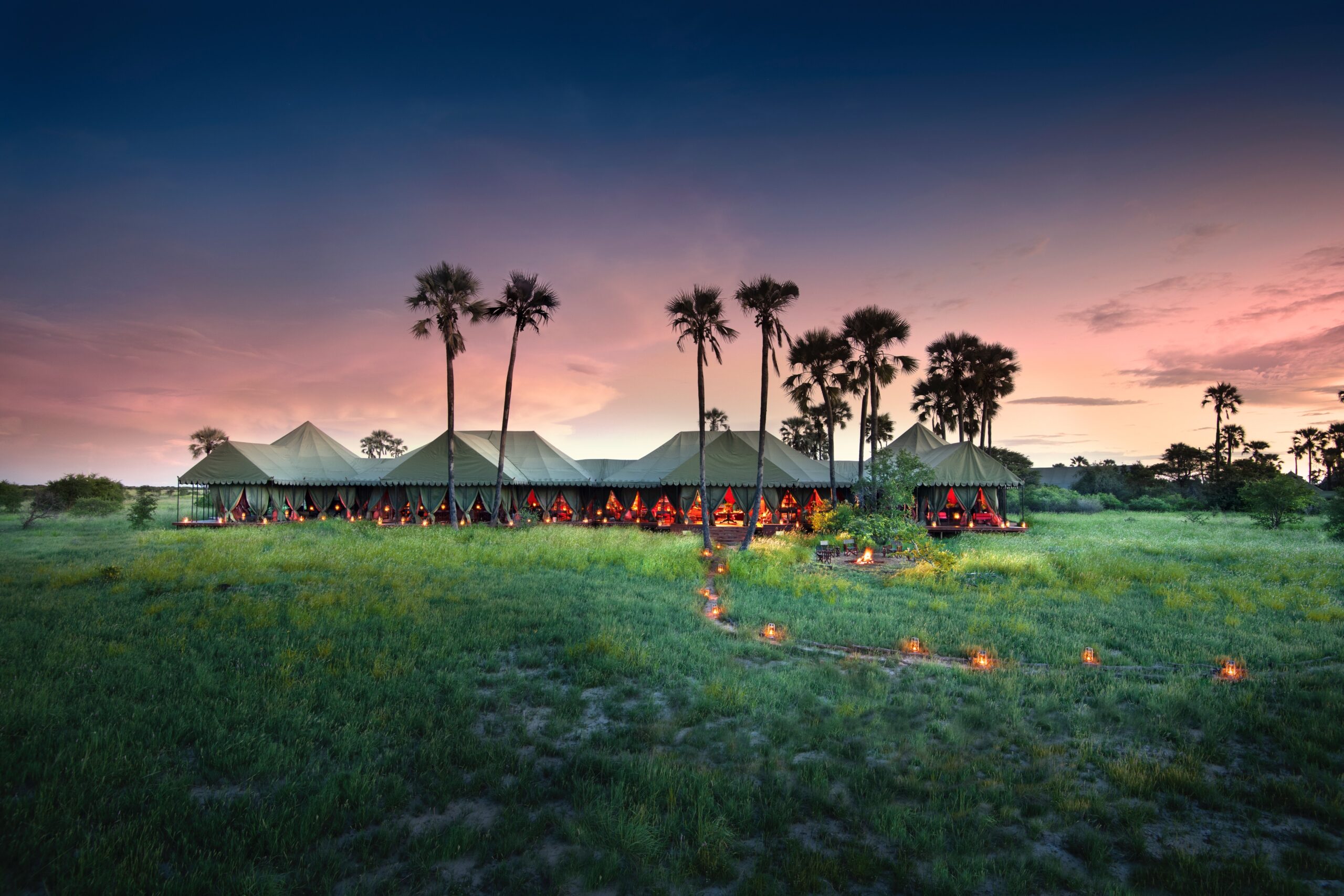
The Makgadikgadi Pans are the remnants of one of the largest lakes ever to exist on earth. When it dried up — roughly ten thousand years ago — it left behind a salt crust the size of Switzerland and a silence that is genuinely difficult to describe to someone who hasn’t heard it. Jack’s Camp sits on its edge, and has done so, in one form or another, since 1993.

The camp itself is a deliberate act of personality. Nine green canvas tents furnished with Persian rugs, brass fittings, copper basins, and natural history cabinets curated by owner Ralph Bousfield — a man who has spent his life collecting interesting things from interesting places. The mess tent houses a 36-seater dining table that served as an officer’s mess in the 1820s. There’s an antique billiard table. A library. A cabinet of curiosities that rewards a slow afternoon of browsing. It looks and feels like the kind of place an eccentric explorer would have set up if he’d had excellent taste and an unlimited budget, which is essentially what happened.

The activities are where Jack’s really earns its reputation for being unlike anywhere else. The meerkats alone justify the trip — a habituated group that emerges each morning from their burrows and treats guests with complete indifference, using them as convenient elevated platforms from which to scan for predators. It is, objectively, one of the more charming wildlife interactions available on the continent.

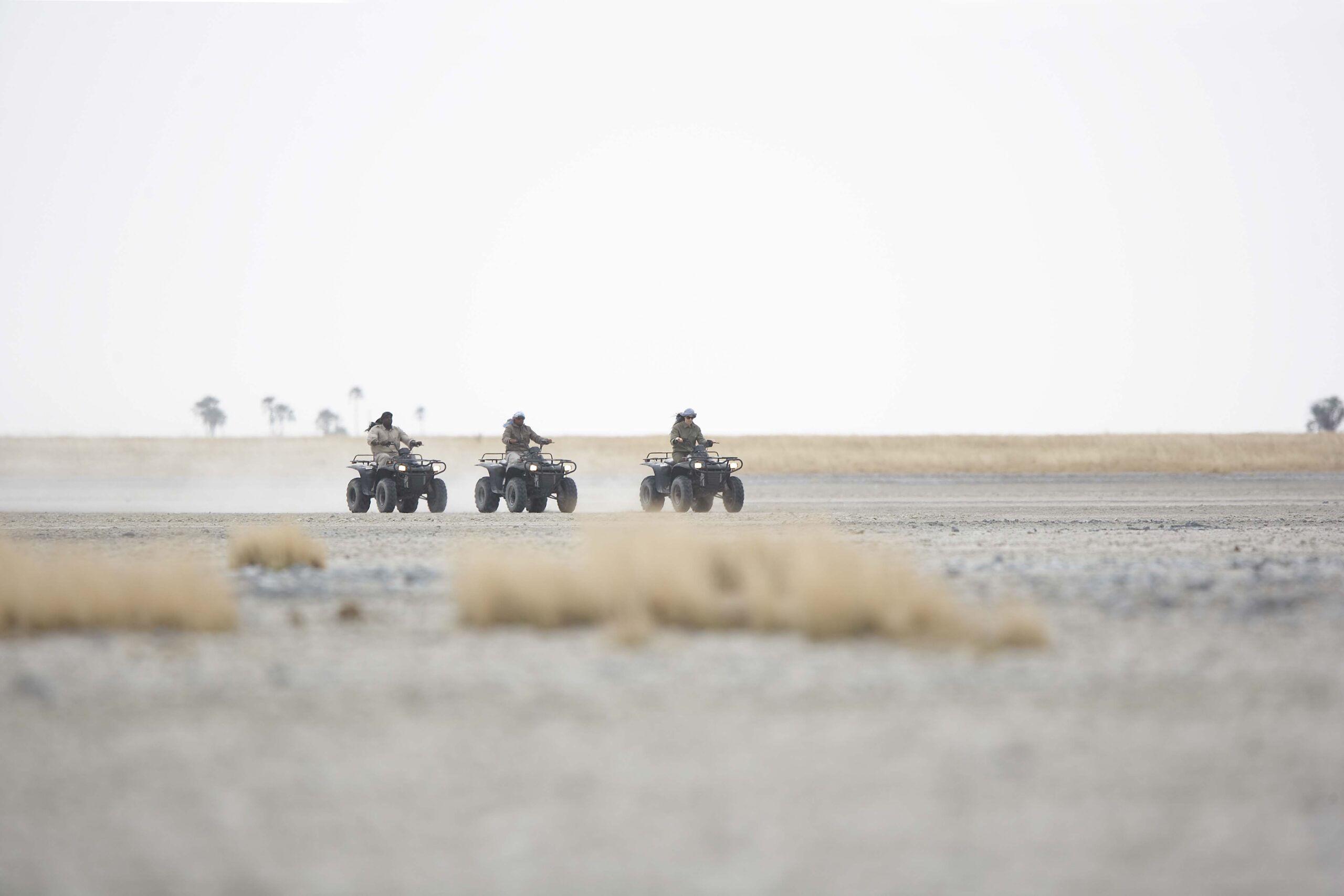
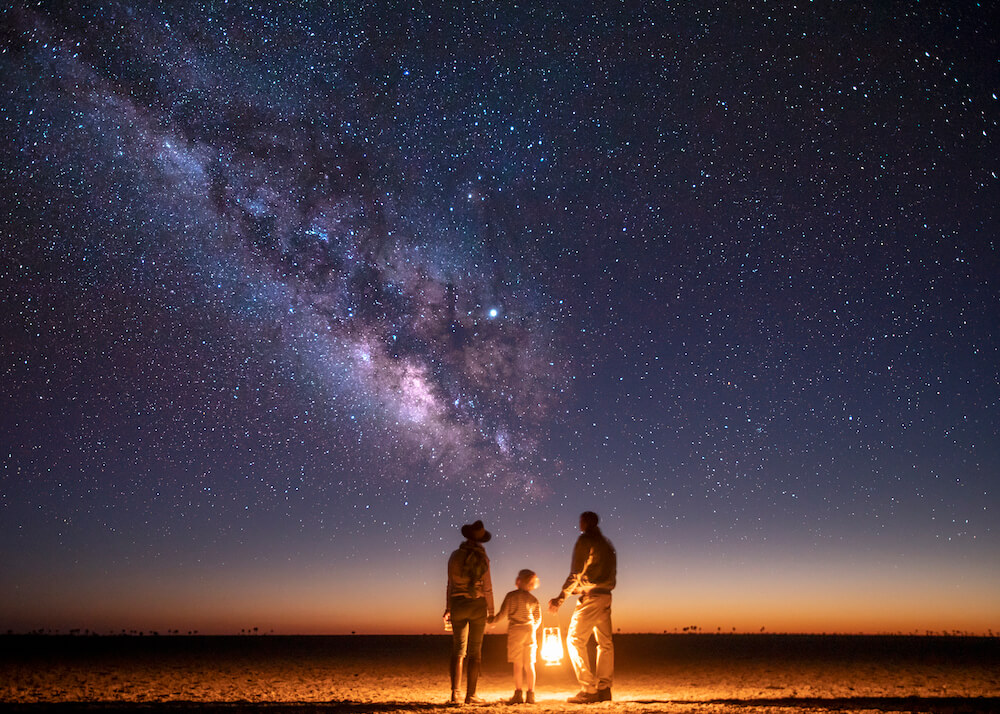
Then there’s quad biking across the salt flats — not a gentle pootle, but a proper sunrise run across a landscape so flat and featureless that you lose all sense of speed and distance. Walking with the San Bushmen, who have lived in and around the Kalahari for tens of thousands of years, brings a human dimension to the experience that most safaris simply don’t offer. And sleeping out on the bare pans under a sky with zero light pollution — the Milky Way so dense it looks almost architectural — is the kind of night that makes everything else feel slightly ordinary by comparison.
The wildlife is different too. Forget the Big Five checklist. Jack’s is brown hyena, Kalahari lion, oryx, aardvark, bat-eared fox. During the green season, the zebra migration — Africa’s second largest — brings tens of thousands of animals onto the grasslands surrounding the pans, followed closely by the predators that track them.

A word of honest advice: if your idea of a perfect safari is maximum game density and a different species every ten minutes, Jack’s Camp is probably not your place. But if you want something that genuinely couldn’t exist anywhere else on earth, and that you’ll find yourself struggling to explain properly when you get home — this is it.

Hoanib Skeleton Coast: Desert Lions, Distant Horizons, and the Luxury of Silence

Safari lovers often talk about sound — the roars, the rustles, the unending nighttime chorus. But Hoanib Skeleton Coast Camp flips the script with a different kind of sensory experience: profound, resonant silence. The kind that expands inside you. The kind that makes a single footstep feel like punctuation in an otherwise blank poem.

Set in one of Namibia’s most remote valleys, Hoanib lies at the intersection of desert, mountains, and the unseen pull of the Atlantic Ocean. At first glance, the landscape appears empty. Your eyes skim over pale dunes and ochre ridges, dismissing them as barren. But Hoanib rewards patience, not haste. Shapes resolve slowly: a lone elephant threading its way along a dry riverbed, a pair of oryx holding still in perfect desert camouflage, a fresh track hinting at the improbable wanderings of a desert-adapted lion.

Days here unfold with an exploratory rhythm. Drives trace ancient river systems carved by rains that may only come once in several years. You follow stories written in sand, piecing together the nomadic lives of animals that survive on astonishingly little. If conditions allow, the journey toward the Skeleton Coast is among the continent’s most surreal drives — a cinematic transition from shimmering dunes to the fog-laden wildness of the Atlantic, where shipwrecks tilt like abandoned punctuation on an unfinished sentence.

Inside camp, the minimalist architecture mirrors the desert: calm, tonal, grounded. Canvas, stone, and pale wood create a sanctuary that amplifies the surrounding quiet rather than competing with it. Meals are unhurried, evenings candlelit, and nights filled not with noise but with space.

Hoanib isn’t about abundance. It’s about revelation. It teaches you to look harder, listen deeper, and appreciate the astonishing resilience of life where it shouldn’t logically thrive. And in doing so, it reshapes your definition of wilderness itself.

Little Kulala: Where Silence Learns to Shine

There are landscapes that feel sculpted. And then there are landscapes like Namibia’s Sossusvlei, where the earth seems to have spent a few million years deciding on the perfect curve of a dune before finally signing its name in sand. It’s here, on a private reserve bordering the iconic Namib-Naukluft, that you’ll find Little Kulala — a lodge so seamlessly woven into its surroundings that it feels less built and more exhaled by the desert itself.

Little Kulala is a study in understatement. Its suites are soft, pale, and impossibly serene — all timber, linen, and clean geometry. They’re the kind of spaces where even time seems to walk more quietly, padding across the floor in bare feet. Private plunge pools shimmer in the heat, rooftop starbeds invite late-night sky worship, and every window frames a view that looks suspiciously like a carefully composed photograph.

But the real magic, as always in Namibia, happens outside the walls.

Mornings begin with air cool enough to make your coffee feel philosophical. The journey into the dunes is a slow unfurling: pastel light, long shadows, oryx silhouettes gliding across the horizon like punctuation marks in an unfinished poem. Climb Big Daddy or Dune 45 if you want a challenge; wander the fossilised trees of Dead Vlei if you want perspective. Either way, the desert has a knack for reminding you how vast the world is — and how refreshing it can be to feel wonderfully small.

Wildlife here is subtle by design. A brown hyena’s tracks etch the sand. A springbok drifts through a mirage haze. A lone ostrich appears exactly where you didn’t expect it, then pretends it meant to be there all along. It’s not a place of abundance; it’s a place of presence.

Back at Little Kulala, afternoons melt into golden silence. Perhaps you retreat to your deck with a book you barely open. Perhaps you sink into your pool while the desert rearranges its colours one degree at a time. Evenings bring lanternlight, deep tranquillity, and stars that seem to multiply just to show off.

Little Kulala is luxury distilled — minimalism with meaning, privacy without pretence, and landscapes so unfiltered they feel almost spiritual. It’s not a place you visit so much as a place that quietly rewrites the rhythm inside you.

Tswalu Kalahari: The Luxury of Isolation

There’s a point somewhere between Upington and eternity where the Kalahari opens up and you start to feel very small. That’s usually the moment you realise you’re getting close to Tswalu.

South Africa’s largest privately protected reserve has never really played by anyone else’s rules. While other lodges might measure their worth in thread count or wine lists, Tswalu deals in something far rarer — space. Here, luxury isn’t about what’s added, but what’s absent: crowds, noise, clutter, deadlines. The silence is a currency all its own.

The new Loapi Camp, Tswalu’s most recent addition, continues this philosophy of elegant restraint — a collection of glass-fronted safari homes scattered like mirages across the dunes. Everything is deliberate yet unforced: natural materials, clean lines, textures that echo the desert itself. It’s architecture designed to defer to the landscape, not dominate it.

But what sets Tswalu apart isn’t just the design — it’s the depth of experience. Tracking pangolins under starlight with researchers. Following a coalition of cheetahs through the ochre grass. Sharing a breakfast of Kalahari truffles and poached eggs while the horizon hums with heat. The encounters here feel less like safaris and more like quiet collaborations with the wild.

Condé Nast’s readers regularly place Tswalu among Africa’s finest, yet its real brilliance is how little it seems to care about that. This is a place that hums to its own frequency — one of patience, purpose, and deep respect.

In a year when Michelin Keys and global accolades are reshaping how we define excellence, Tswalu stands as a gentle reminder: true luxury isn’t found in perfection, but in perspective. It’s the feeling of being utterly alone, yet completely connected — to the land, to the moment, to something far older than both.

Shipwreck Lodge: Unfettered Wilderness

The Skeleton Coast National Park is officially the least visited of all of Namibia’s parks. If it is true, unadulterated wilderness you ejoy, then this is the place to find it.
Shipwreck Lodge is located in the Skeleton Coast Central Concession Area, a critically important piece of land for protecting vulnerable wildlife species. The lodge is a joint venture between Natural Selection and local Namibian companies Trip Travel and Journeys Namibia, as well as the local communities that border the park. The future of African conservation lies firmly in fostering community involvement, and Shipwreck Lodge epitomises such an approach.

Uniquely designed around the enigmatic shipwrecks that line the coast, there’s nowhere on the continent quite like Shipwreck Lodge, which is certainly Iconic Africa’s pick of top lodge from which to explore this part of the world.
In fact, there’s nowhere on the continent quite like the Skeleton Coast. It’s a raw, rugged and impossibly remote slice of African wilderness, where towering dunes and wind-swept plains roll as far as the eye can see, buffeted by the icy Atlantic ocean.

But there’s much more to the area than just the isolation factor. Go on game drive in search of desert-dwelling fauna like oryx, springbok, desert-adapted lion and elephants; discover the enchanting desert flora (succulents and lichens); sit atop the dunes as the sun sinks below the horizon; spend the day beach-combing for whale bones and debris from centuries of shipwrecks; and marvel at the geologically-remarkable Clay Castles. This is truly a unique environment!

The words ‘eerie’ and ‘mysterious’ are often bandied around when it comes to describing Africa’s most interesting locations, but the Skeleton Coast has to be one place that truly deserves the metaphors. Shrouded in mist, the jaw-droppingly beautiful National Park begins at the Ugab River and runs roughly 500 kilometres up the Atlantic Coast to the Kunene River, which forms the border between Namibia and Angola for a few hundred kilometres inland.. Described by the San Bushmen as ‘the Land God Made in Anger’, the beaches are strewn with bleached whale bones and the wrecks of over a thousand ships, and the interior is an uninhabited desert of rolling, endless sand. But it’s magical and hauntingly picturesque, and, in our books, that makes it an absolute must-see.

Shipwreck Lodge itself is located in an unrivalled spot in the Skeleton Coast Central Concession Area, a piece of land between the Hoarusib and Hoanib rivers. The lodge is within the Skeleton Coast National Park and roughly 45 kilometres from Mowe Bay. The area contains irreplaceable and vulnerable wildlife habitat for species of the highest conservation importance, including elephant and the elusive brown hyena. Importantly, it also hosts the only other viable lion population in Namibia outside of Etosha National Park.

The Skeleton Coast is an area known primarily for its extraordinary landscapes and wide open vistas. Wildlife is not densely populated in this arid environment, so when do you spot something, it’s that much more special. Giraffes, mountain zebras, brown hyenas… creatures that just seem to belong and some that seem totally incongruous with this part of the world. Plants and insects survive from the moisture of the cold fog that drifts inland from the ocean, and the ocean itself is brimming with life. The nutrient-rich Atlantic supports a huge population of Cape fur seals, whose colonies dot the shoreline. Birdlife here features a number of special endemics, so make sure your binoculars are packed…

The lodge itself features ten rooms; 8 as twins or doubles and two family rooms. Each features an en suite bathrooms with indoor showers, and hairdryers are available on request. Charging facilities, a laundry service, and all the mod cons one would expect from a quality operation are found here, including wifi in the main area.

The Skeleton Coast stays relatively cool throughout the year, governed by the cool temperatures of the Atlantic, more specifically the Benguela current that comes sweeping up the coast from Antarctica, but venture away from the coast and temperatures can change just like that, going from freezing to boiling in a very short space of time. Always pack a jersey when heading on an excursion!

If you enjoy solitude, deep relaxation and the complete absence of time pressure, then Shipwreck Lodge is the place for you. The lunar landscapes will leave you both breathless and enchanted, and when it comes time to leave, it’ll feel like you’ve been there for both a day and two weeks.

Get in touch with us through info@iconicafrica.com to find out more about this unique destination, and the Skeleton Coast in general…

Sossusvlei Desert Lodge: Quietening the Soul

Sossusvlei Desert Lodge is set in a veritable ocean of tranquility; a vast 12,715 hectare (31,419 acre) expanse deep in the Namib , the world’s oldest living desert.

Tucked discreetly against a rocky outcrop amidst a seemingly endless sea of red dunes and gravel plains, the utter tranquility and extraordinary clarity of light makes this area one of Africa’s most compelling landscapes. The night skies are heavenly, with the concession bordering the International Dark Sky Reserve (recently declared one of the two quietest places on earth) of the Namib Rand Nature Reserve. A canvas of beauty that invites reconnection with yourself and nature.

Sustainability and uncompromised luxury go hand in hand at Sossusvlei; 10 beautifully appointed stone and glass suites, spread out along the curve of the escarpment, open onto ever-changing outlooks. Each spacious air conditioned suite offers a secluded, shaded veranda complete with private plunge pool, a living room with a fireplace, a large retractable skylight above the bed, and an ensuite bathroom with a glass-encased rain shower offering 180º desert views. The two-bedroomed Star Dune Suite is an ideal option for families or groups of friends.

The split-level guest area is an inspired masterpiece of glass, rock and steel. Large glass panels fold away to reveal unobstructed desert vistas. Inviting amenities include a central-island bar, comfortable sitting room, walk-in cellar, interactive kitchen and rim-flow pool. Other signature features include numerous shaded, private spaces; a sunrise-view gym and sunset-facing wellness centre which offers both a treatment room with a private spa-bath, and a separate wet-room spa. The lodge’s Signature Shop showcases Namibia’s finest craft offerings.

Immerse yourself in the ultimate safe travel bubble as you enjoy an array of private experiences, delectable dining, myriad adventures and spectacular accommodation. Among these vast ancient vistas, a thousand tiny miracles play out each day, as fascinating desert animals and plants make dozens of unique adaptations that allow them to thrive in this arid environment. Natural beauty on a grand scale stretches beneath impossibly blue African skies. Stripped down to barest simplicity, the desert playground of Sossusvlei is the ideal place to reawaken your soul.

Get in touch through info@iconicafrica.com to find out about rates and availability, and to explore more about a potential Namibian itinerary…


Tswalu Green Season Special

Stretching for 114,000 hectares across the southern Kalahari, Tswalu is South Africa’s largest private game reserve and a destination in its own right.

Dramatically scaled landscapes, breathtaking vistas, diverse habitat with fascinating fauna and flora, and a wide choice of privately guided safari experiences set the scene for a safari of unparalleled exclusivity and freedom. Game drives here are something entirely different. Space is what you feel. Horizons, vistas and timelessness. The unique wildlife adds its own flavour to the reserve, but for the most part you simply feel awed by the sheer expanse of this wilderness that most of the time feels like its all yours.

With the opening of Loapi Tented Camp’s six private tented safari homes, guests can now enjoy the best of Tswalu and explore the destination with an incredible 6-night itinerary that includes three nights at the Motse (first night free) followed by three nights at Loapi. With this first-ever dual camp offer from Tswalu, they are also including complimentary return flights to Tswalu from Johannesburg or Cape Town with Fireblade Aviation for two adults. Children pay 50% of published flight costs.

Pioneering and nomadic in spirit, Loapi Tented Camp’s individual safari homes are surrounded by open savannah grasslands and accommodate two or four guests for the ultimate private wilderness experience. The 4 one-bedroom homes and 2 two-bedroom homes, spanning over 300 square metres and over 400 square metres respectively, are for those who are after complete privacy whilst on safari. Sustainably designed and environmentally sensitive, each tented home is tucked into the contours of a valley set in the Korannaberg mountains. The six homes are at least 50 metres (165 feet) apart to ensure privacy and solitude. Personal service is provided by a dedicated house manager and all meals are prepared by a private chef in the interactive kitchen. As with all our camps, a private safari vehicle, guide and tracker is guaranteed.

Motse is the larger of the two luxury safari camps, and was designed with individual couples and families in mind, and accommodates a maximum of 18 adults in nine legae or suites.
Indigenous gardens throughout the camp are a haven for antelope and birds (many of which are endemic to the area), while a waterhole in front of the main guest area attracts a variety of wildlife, especially in the dry season. The main camp’s communal guest area comprises a series of generous spaces for relaxing and dining indoors and outdoors. Covered verandas lead to two swimming pools and a fire pit for sundowners. The main lounge has a feature stone fireplace, mezzanine library and walk-in wine cellar stocked with premium South African wines. An intimate boma is the setting for barbecue dinners under the stars. The Tswalu Spa is situated at the Motse, along with a Gym, Photographic Studio and the Gallery, a boutique stocked with art, jewellery, clothing and souvenirs.

Tswalu is an utterly unique safari experience. We cannot recommend it highly enough, especially for those who have previously enjoyed a safari in the traditional bushveld of the Kruger Park or surrounds. This is something else entirely.

Get in touch through info@iconicafrica.com to find out more…

Terms and Conditions: Promotions are mutually exclusive and cannot be combined or used in conjunction with any other special rates or promotions | Offer must be requested at the time of booking and cannot be applied retrospectively | Booking validity: for new reservations, from 1 September 2023 to 15 December 2024.

Hoanib Skeleton Coast: the Desert Elephants

It is truly astounding to see the world’s biggest land animal trundling its sedate way across a seemingly endless gravel plain, not a drop of water in sight, and with only the haze of rocky mountains rising up in the distance.
There is almost nowhere in the world where you can witness such a seemingly incongruous presence of wildlife.

Yet the desert elephants of north Namibia have become specialised denizens of this harsh yet spectacular environment. They know where the hidden springs in the mountains are. They eat only sparingly from the big trees that occur in the ephemeral riverbeds, never pushing one over (they know that should they do, that tree will not be able tor provide food next year), and this wisdom is passed down from generation to generation.

The Kaokaveld – the name given to this north-west corner of one of earth’s most sparsely inhabited countries – is at first glance barren and lifeless, but look a little closer and you will discover a myriad of inhabitants, all of which have evolved over millenia to make this rocky desert their home.
It is truly one of the most fascinating ecosystems in the world, and the Hoanib Skeleton Coast Camp is one of the best places from which to experience it.

Set alongside the Hoanib river, which forms the boundary of the Kaokaveld to the north and Damaraland to the south, the lodge is perfectly positioned to enjoy the best of both ecosystems.

Eight pale olive, generously appointed, tented suites peak like whitecaps on an ocean of sand. Totally solar-powered, their open design and colour palette reflect the surrounding desert, keeping the interiors startlingly cool. A unique experience beckons for the intrepid traveller seeking chic luxury in a startlingly rugged and isolated, ancient landscape.

Yet this remote part of the world is by no means just about the desert elephants, even though they are the star attraction.

Giraffes wander between the hills, obtaining moisture from the few leaves they eat off the scrubby vegetation. Brown Hyenas – cousins of the more well-known spotted variety – scavenge for delicacies like ostrich eggs, or prey on seals down on the skeleton coast, and even lions are seen, walking many many miles each day in search of prey like the stately oryx or the springboks which come and go, following the sparse grazing.

This a place where space and isolation are the true magic ingredients. Seldom will you have ever felt a silence more profound, or felt as awed by a landscape so vast and ancient. It seems paradoxical yet there is a friendliness to the desert here that makes you feel at home in the harshest of environments.

The Kaokaveld is not about the volume of wildlife you will see; that is for elsewhere. Instead it is about a deep dive into a fascinating ecosystem, to which some of Africa’s most iconic fauna have managed to adapt despite the odds.

It is about space, and time, and stillness. It’s about starlight.
And of course it’s about the elephants.

Get in touch through info@iconicafrica.com to find out more about this remarkable corner of our planet, and let’s start planning your safari…

The Best Places to View Elephants in Africa

Although Elephants are prevalent in many of the more famous game reserves across Africa, they are seldom the reason to visit a specific park or area. The spotlight is generally reserved for the big cats or some other nuanced factor like a rare species or specific behaviour that occurs there.
A lot of the time, as spectacular as they are, the presence of elephants can almost get taken for granted by visitors to Africa, and the viewing of them seen as a guaranteed byproduct of a safari.
Yet there is a tremendous amount of variability in elephant populations across the continent. In some areas they are scarce and nervous of vehicles, in others they are massively overpopulated, sometimes their presence is seasonal, and they are hardly to be found during certain months of the year…

If it is elephants that you want to see, it is imperative that you know where the best places are, and what to expect once you are there.

Here a few of our favourite places to view elephants in Africa…

MANA POOLS

As unique an elephant experience as you’ll get, if you visit between June and October. The local elephant population congregates along the Zambezi River to take advantage of the availability of water at the height of the dry season, and to feed on the pods of the Ana Trees that fall to the ground during this time of year.

The true magic of Mana Pools lies in the freedom guests have to go on foot whenever they wish (although the uninitiated should only do so when accompanied by a professional guide). Mana Pools is the only National Park that allows its visitors to alight from their vehicles and approach wildlife whilst walking.

As a result, the local animals have grown used to seeing humans on foot, and as long as respectful distances are maintained, accept people’s presence. 

Being 40 metres from a large African Elephant bull when on foot is just as if not more exciting than having one brush right past your safari vehicle.

With amazing accommodation options on some of the more exclusive concessions on the east and west sides of the park, as well as a couple right in the heart of it, Mana Pools is there to explore…

AMBOSELI, KENYA

The true Giants of Africa live here. Famous super tuskers like Craig and Tim – old bulls carrying some of the biggest ivory in Africa – call this ecosystem their home, and what could be more iconic than an enormous elephant bull with a backdrop of Africa’s tallest mountain, Kilimanjaro?

There are few images that are as quintessentially Africa as this.

Photo Credit: Jeff Wendorff

Between the Amboseli and neighbouring Tsavo ecosystems there are a number of super tuskers (elephants classified as carrying tusks of over 100 pounds) with even more so-called emerging tuskers – younger individuals who are on track to carry enormous ivory – so one’s chances of seeing a truly spectacular elephant are high.

Alongside the rest of the resident wildlife like lions, cheetahs and a whole assortment of the weird and wonderful, the Amboseli and Tsavo regions provide some of the best elephant viewing on the continent.

SABI SAND, SOUTH AFRICA

Plenty of relaxed elephants, plenty of lodge options.. The Sabi Sands is one of Africa’s best places to view wildlife. Known particularly for its leopards – the reserve boasts the densest population yet recorded in Africa – this is one place where elephants almost are a by-product of looking for big cats.
Non-impactful viewing practices over the last fifty years have resulted in local wildlife populations that are completely relaxed in the presence of a vehicle, and close-up sightings of elephants are commonplace. Being completely surrounded by a herd is not at all unlikely, and an experience like this will quite simply take your breath away.

With a wide variety of accommodation options catering for a range of budgets and needs, the Sabi Sands is an excellent place in which to get cloe to elephants, and at the same time enjoy some of the most spectacular wildlife viewing on the planet…

NAMIBIA

Namibia is one of the most unique places you can see elephants, and one small population in particular.

In the far north-western corner of Namibia lie the Kaokaveld and Damaraland regions, which are home to the fabled desert elephants. These animals have adapted to survive in the harshest environment, sometimes walking round trips of 70km in their search for water.

The lunar landscape is the last place one would normally expect to view elephants, and it is the setting itself that makes sightings that much more spectacular.
There are a few isolated yet luxurious camps tucked discreetly away in this desert wilderness, the guides of which know exactly where to find the herds at different times of year, so despite the elephants being few in number and the wilderness so vast, encountering them is still a likelihood.

Ultimately, elephant viewing in Africa is as diverse as the continent itself, and our feeling is that it almost doesn’t count as a safari unless elephants are part of it. Almost…

Get hold of our safari consultants through info@iconicafrica.com to start planning your elephant safari…

3 of Africa’s Best Hidden Safari Gems

One of the hardest things about choosing a safari destination is simply wading through the huge amount of choice you get given. Literally hundreds of lodges and camps spread all over the continent, from desert to mountaintop and everything in between.

Yet every now and then a really special place pops up on one’s radar, somewhere that immediately gets you thinking about a return visit.

We’ve picked three that we’ve come across on our own travels that we simply cannot recommend strongly enough…

Kicheche Valley Camp

There are few safari camps out there that give you an overwhelming feeling of “Yes!” when you walk onto the deck for the first time. Kicheche Valley Camp is one of them.

Tucked discreetly between two acacia-covered hills in the Naboisho Conservancy of the eastern Maasai Mara in Kenya, the camp has a wonderful simplicity to it that instantly draws you into a slower pace of life. Zebras graze within metres of your tent, lions (of which there are plenty in the area) roar in the distance at night, and the camp staff’s warm smiles and enthusiasm for their work are clearly genuine.

Kicheche have a number of offerings in the area (Bush, Mara and Valley Camp), but Valley has to be our favourite; the intangibles there make it evident that nothing is forced, everything is done at your pace, the food is excellent, the drinks are cold, the accommodation makes you feel like are part of the environment instead of excluded from it – whilst still being incredibly comfortable – the guides are excellent, and of course, the wildlife viewing is utterly spectacular.

For those looking for a wildlife destination in East Africa that ticks all the boxes, but most importantly the one about feeling at home, look no further than Kicheche Value Camp.

Notten’s

Neighbour to some of the biggest name lodges in the South African safari industry, Notten’s has been quietly in operation since the 1980s, conducting Big 5 safaris with their own special brand of charm and hospitality.
As part of the Sabi Sand Reserve, Notten’s boasts just as high a density of big game as any other lodge in the area, with a particularly high number of leopards and lions calling the area home. The Sabi Sands is in fact home to the densest population of leopards yet recorded in Africa.

Notten’s has a family feel to it; it is family run and many of its staff have their own families living and working there. This is reflected in the warm welcome that everyone receives, and the level of repeat business that Notten’s can boast (among the highest in the greater reserve) is testament to this fact.

Whilst other destinations close by might be better known, it is Notten’s that will have us going back time and time again.

Nxai Pan

When the Okavango Delta, a world-heritage site and one of the most sought-after safari destinations in Africa is only two hour’s drive away, it’s hard to compete.

Yet Nxai Pan offers a completely different type of safari experience, a highly concentrated one that is difficult to find anywhere else on the continent.
Set in the vastness of the greater Kalahari Desert, the pan itself – and accompanying pans to the south – offer an incredible open reprieve from the surrounding scrubland.
Short grass plains and salt pans stretch as far as the eye can see, presenting incredible game viewing opportunities.

Water is everything here, and with only one or two permanent water sources in the dry season, incredible concentrations of wildlife – most notably elephants – are to be found coming to slake their thirst each day.

Nxai Pan is a unique ecosystem that will leave you in awe at its scale. Baobabs dot the area, and a trip to this part of the world would not be complete without a day trip to the world famous Baines’ Baobabs just to the south.

Although open year round, the game-viewing at Nxai Pan tends to be seasonal in response to water availability, so be sure to connect with one of our travel consultants to find out about the best time to visit.

And with the Okavango just a short safari stone’s throw away, this reserve offers the perfect place to incorporate into the wider Botswana safari circuit…