Grootbos: Where the Secret Garden Goes Global

Recognition tends to find those who aren’t chasing it. So it feels fitting that Grootbos Private Nature Reserve, a property defined by restraint and regeneration rather than self-promotion, has just been named 5th in Condé Nast Traveler’s Readers’ Choice Awards for South Africa’s Top 15 Resorts.

Tucked between mountain and sea near Gansbaai, Grootbos has always felt slightly out of category — too wild to be a vineyard retreat, too elegant to be called an eco-lodge. It’s its own species entirely: a place where the word luxury is defined less by opulence and more by intention.

The reserve protects over 2,500 hectares of fynbos, one of the world’s most biodiverse floral kingdoms, and its story has always been as much about what grows outside the rooms as what’s inside them. Suites open onto views where the ocean feels stitched to the sky; the air carries the faint honey scent of proteas; and the architecture — all glass, timber, and understatement — feels designed not to compete, but to frame.

Condé Nast readers have long rewarded beauty, but here they’ve also rewarded purpose. Grootbos runs on solar energy, champions community development through its foundation, and supports local conservation and research projects that ripple well beyond the reserve’s borders. Every stay helps sustain that mission — which might be the most modern definition of luxury we have.

At a time when the world’s finest lodges are being recognised by Michelin, by Condé Nast, by whoever next holds a clipboard of merit, Grootbos’s achievement feels especially resonant. Because what it really celebrates is balance: design and wildness, comfort and conscience, people and place.

To walk through a field of blooming fynbos at dawn, then return to a breakfast plated like fine art, is to understand exactly why Grootbos stands among the best. It’s not just about where you stay — it’s about what stays with you.

What Would It Take for a Safari Lodge to Earn a Michelin Key?

Until now, Michelin has mostly told us where to eat, not where to sleep. But that’s changing. The famed guide has unfurled a new rating system for hotels and lodges — the Michelin Key — a sibling to the coveted Michelin Star, and a new yardstick for excellence in stays.

It’s an intriguing idea for the safari world, where barefoot luxury and wilderness don’t always fit neatly into the same tick-box criteria. How do you score a night filled with lion calls against a night filled with thread counts?

Michelin’s inspectors look for five things: architecture and design, consistency of service, personality, value for money, and connection to place. It’s that last one that feels most relevant to safari lodges. Connection to place is the heartbeat of the experience — the sense that the land, the wildlife, and the people aren’t just backdrops, but protagonists in the story.

By those standards, Africa already has its share of Michelin-worthy contenders. The design brilliance of Singita Sabora, the restraint and intimacy of Mara Nyika, the wild purity of Busanga Plains, and the playful luxury of Ulusaba all whisper the same thing: this is excellence defined by soul, not excess.

Of course, no one’s likely to find an inspector with a clipboard crouched beside a termite mound anytime soon. The Michelin Key isn’t just about imported standards — it’s about recognising that the best stays, like the best meals, create something intangible. A mood. A memory. A moment that lingers.

So, what would it take for a safari lodge to earn a Michelin Key? Probably the same things that make the bush unforgettable in the first place: an architecture that listens to its surroundings, service that anticipates without intruding, and a sense of belonging so strong it feels as though the land itself has checked you in.

If that’s the benchmark, Africa’s already set the table. Michelin just needs to find a way to reach it.

Londolozi Earns Three Michelin Keys: Where Connection Is the True Currency

The Michelin Guide has spoken — and Londolozi has joined a rarified circle. In the inaugural list of global lodges recognised for excellence in hospitality, Londolozi has earned Three Michelin Keys, the highest possible rating.

For those unfamiliar, the new system is Michelin’s way of recognising the world’s most extraordinary places to stay — where design, service, character, value, and connection to place combine into something unforgettable. The restaurant world has long had its stars; now the lodging world has its keys. And in Londolozi’s case, the metaphor fits perfectly.

Because a stay here really is about unlocking something — not just a door to your suite, but a door into the wilderness itself. The luxury is evident, of course: the seamless service, the design that whispers rather than shouts, the food that would make even a Parisian inspector pause mid-bite. But it’s the connection that sets Londolozi apart. Connection to land, to community, to guests, and to a philosophy that’s been evolving for almost a century.

You feel it in the quiet professionalism of a tracker reading leopard spoor at dawn. You feel it in the stillness of the river at sunset, when the light folds over the granite outcrops and the bushveld seems to exhale. You feel it in the staff who’ve worked here for generations — living proof that hospitality, when done right, becomes heritage.

Michelin calls the Three-Key rating “an extraordinary stay.” But that hardly covers it. Londolozi doesn’t just offer extraordinary stays; it offers perspective. It reminds guests that luxury isn’t about what’s added, but what’s revealed when everything unnecessary falls away.

Earning Three Keys isn’t just a nod to Londolozi’s excellence — it’s an acknowledgment of its ethos: that true hospitality has always been about belonging. The kind that doesn’t just welcome you for a night, but stays with you long after you’ve left.

Tswalu Kalahari: The Luxury of Isolation

There’s a point somewhere between Upington and eternity where the Kalahari opens up and you start to feel very small. That’s usually the moment you realise you’re getting close to Tswalu.

South Africa’s largest privately protected reserve has never really played by anyone else’s rules. While other lodges might measure their worth in thread count or wine lists, Tswalu deals in something far rarer — space. Here, luxury isn’t about what’s added, but what’s absent: crowds, noise, clutter, deadlines. The silence is a currency all its own.

The new Loapi Camp, Tswalu’s most recent addition, continues this philosophy of elegant restraint — a collection of glass-fronted safari homes scattered like mirages across the dunes. Everything is deliberate yet unforced: natural materials, clean lines, textures that echo the desert itself. It’s architecture designed to defer to the landscape, not dominate it.

But what sets Tswalu apart isn’t just the design — it’s the depth of experience. Tracking pangolins under starlight with researchers. Following a coalition of cheetahs through the ochre grass. Sharing a breakfast of Kalahari truffles and poached eggs while the horizon hums with heat. The encounters here feel less like safaris and more like quiet collaborations with the wild.

Condé Nast’s readers regularly place Tswalu among Africa’s finest, yet its real brilliance is how little it seems to care about that. This is a place that hums to its own frequency — one of patience, purpose, and deep respect.

In a year when Michelin Keys and global accolades are reshaping how we define excellence, Tswalu stands as a gentle reminder: true luxury isn’t found in perfection, but in perspective. It’s the feeling of being utterly alone, yet completely connected — to the land, to the moment, to something far older than both.

Ulusaba: Safari, With a Wink

Most luxury lodges lean on hushed tones and reverence for the wilderness. Ulusaba, Richard Branson’s private slice of the Sabi Sand, does all that — but it also has a twinkle in its eye. It’s safari, yes, but safari that knows how to have a little fun.

The property is split between three lodges: Rock Lodge, perched high on a koppie with views that stretch forever, and Safari Lodge, tucked into the riverine forest where rope bridges link treehouse-style rooms. And then there’s the newest kid on the block: Cliff Lodge; just two ultra-private suites carved into the rock, perfect for families or friends who want the whole “this is OUR patch of Africa” feeling. Private pools, epic decks, and views so good you might forget to go on game drive (don’t worry, the rangers will remind you).
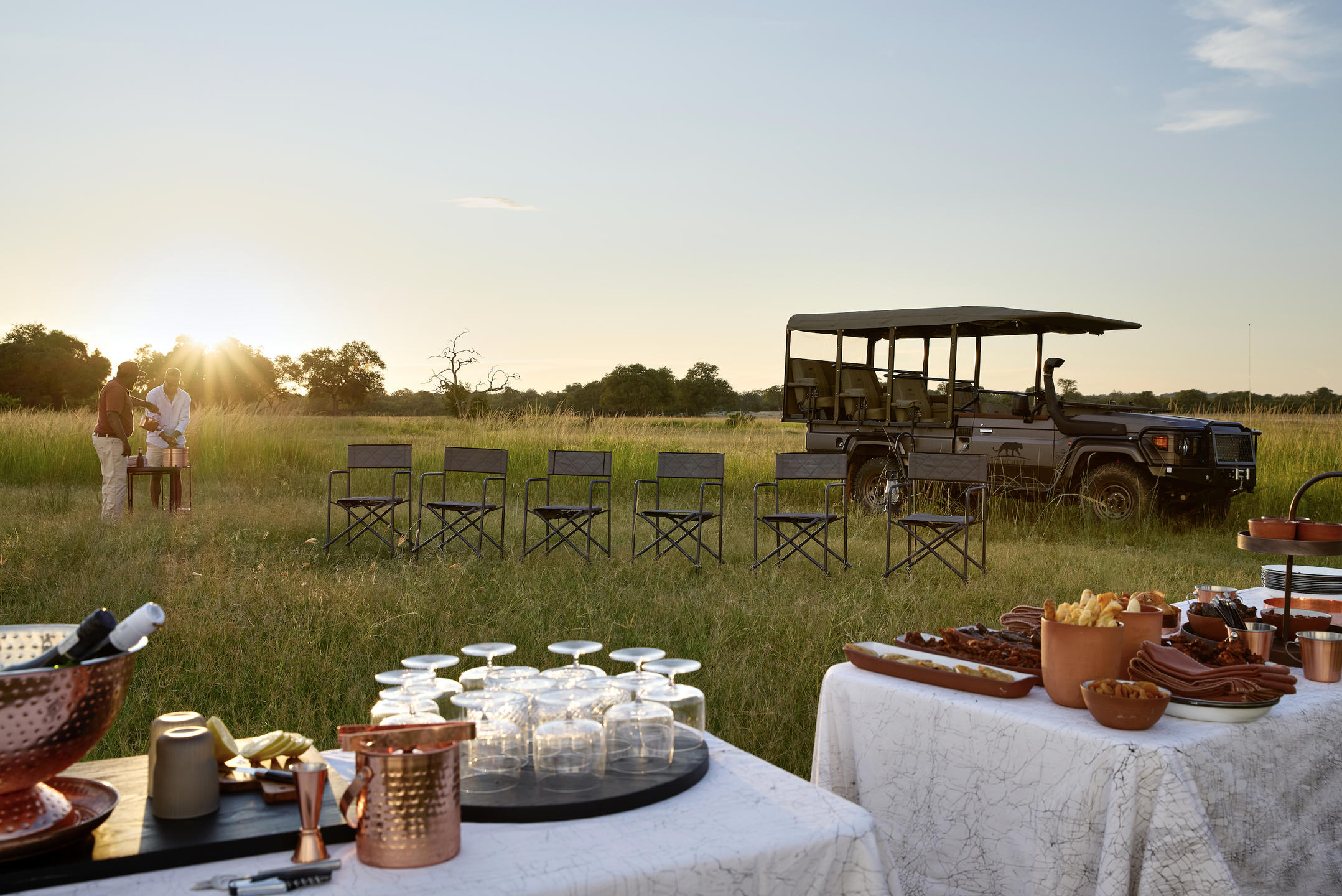
All three come with the sort of playful details Branson is famous for — think surprise champagne stops in the bush and the kind of storytelling that turns an ordinary sundowner into a small event.

Wildlife here is the main draw, of course. Ulusaba sits in the heart of the Sabi Sand, one of the best places on Earth to see leopards. Lions, rhinos, buffalo, and elephants make daily appearances, but it’s the frequency and intimacy of big cat sightings that has made this region legendary. The rangers and trackers here are sharp, and they know how to read the land with the kind of confidence that comes only from decades of experience.

Yet what sets Ulusaba apart is its refusal to take itself too seriously. The service is seamless, but never stiff. Staff banter with guests as though you’re part of the family, and evenings often end with laughter rising into the night alongside the distant roar of a lion. If other lodges are symphonies, Ulusaba is more like jazz: polished, but with a streak of improvisation that keeps it fresh.

For all its playfulness, the lodge doesn’t skimp on indulgence. Rock Lodge has a wine cellar and spa treatments with sweeping views. Safari Lodge offers shaded pools and private decks perfect for doing absolutely nothing. And when the day’s game drive is done, you can expect a dinner that balances serious culinary flair with a sense of occasion.

Ulusaba is proof that luxury can be lighthearted. That you can sip fine wine and watch the sunset, but also laugh when the resident vervet monkeys make a grab for your toast at breakfast. Because the best safaris aren’t just about what you see — they’re about how it all makes you feel. And Ulusaba makes you feel alive, in on the joke, and right at home.

Busanga Plains: Where Luxury Tiptoes Into the Wild

If Singita Sabora feels like theatre, Busanga Plains is closer to unscripted documentary — no retakes, no stage lighting, just the raw pulse of the African wilderness.

Deep in Zambia’s Kafue National Park, the camp sits in the middle of a seasonally flooded grassland so vast it makes the horizon feel like a rumour. For much of the year, these plains are inaccessible. When the waters retreat, they reveal one of Africa’s most dramatic safari arenas: red lechwe bounding through the shallows, herds of puku grazing in golden light, and lions that have learned to hunt where most cats would hesitate to get their paws wet.

Busanga Plains Camp itself doesn’t try to outshine the setting. It couldn’t, and it doesn’t need to. The lodge is deliberately small, with just a handful of tented suites raised on wooden decks. You’ll find comfortable beds, hot showers, and lantern-lit dinners — but don’t expect chandeliers or wine cellars. Here, the luxury is space. Silence. The sense that you’ve stumbled into Africa before the world got crowded.

Game drives roll out across the plains like expeditions. Some mornings are about elephants and buffalo drifting through the mist. Others deliver the famous Busanga lion prides, often lounging on termite mounds like they own the place (which they do). If you’re lucky, you might spot a cheetah carving a line through the long grass, or watch crowned cranes rising in a flurry of wings as the sun sets.

Evenings back at camp are their own reward. Sitting by the fire, the vastness pressing in from all sides, you become acutely aware of just how remote you are. No highway hum, no faint glow of a distant town. Just stars — millions of them — and the steady chorus of the marsh.

Busanga isn’t safari with trimmings; it’s safari distilled. It’s for travellers who crave the edge of adventure but still appreciate a crisp linen sheet at the end of the day. The kind of place that makes you feel small, in the best possible way.

Mara Nyika: a Camp That Whispers Rather Than Shouts

Some lodges announce themselves before you’ve even unzipped your bag. Brass fittings, oversized chandeliers, the kind of bath you could launch a canoe in. Mara Nyika is not one of those lodges.

Perched lightly among the flat-topped acacias of the Naboisho Conservancy, Nyika doesn’t so much dominate the landscape as blend into it, like a well-worn canvas jacket. You could walk past its guest tents without even realising you were skirting one of Kenya’s most refined safari outposts. And that’s very much the point.

Naboisho itself is part of the magic: a vast conservancy bordering the Maasai Mara National Reserve, but with far fewer vehicles, more privacy, and a fierce dedication to conservation. Lions patrol the savanna here with the same swagger you’ll see inside the Reserve proper, while cheetahs, giraffes, and elephants all make daily cameos. The difference is that you’re unlikely to be sharing the sighting with a convoy of Land Cruisers.

Mara Nyika leans into this ethos of understatement. The camp’s design is all flowing canvas, polished wood, and gentle curves that feel more like an extension of the trees than an intrusion. Step inside your suite and you’ll find the kind of detail that makes luxury feel effortless: a desk positioned to catch the morning light, copper accents that glow at dusk, a bathtub with a view that doesn’t require explanation.

But perhaps the greatest luxury is what you don’t see. No rush, no crowds, no clutter. Just space — for animals to roam, and for you to think, breathe, and reset. Evenings here are less about theatrical fanfare and more about quiet conversations around the fire, punctuated by a distant hyena call or the shuffle of elephant feet through the grass.

For those who like their safaris with a little narrative arc, Nyika also serves as a gateway. It connects seamlessly with Great Plains’ other Mara properties, so you can trace your own journey across the ecosystem, following the migration if the timing’s right.

Still, you may find yourself reluctant to move on. Mara Nyika is one of those rare places where the definition of luxury isn’t excess, but restraint. Where the whisper carries further than the shout.


Singita Sabora: Serengeti Theatre

Some places you check into. Others, you quite literally arrive. Singita Sabora is firmly in the latter camp. It doesn’t just sit in the Serengeti; it unfurls across it, like a lavish set design waiting for the curtain to rise.

Set in the private Grumeti Reserve, Sabora has all the cinematic grandeur you’d expect from Singita, but with a modern twist. Think sweeping canvas tents — though “tent” feels like a disservice when your suite has Persian rugs, curated antiques, and a four-poster bed that could comfortably accommodate a small wildebeest herd. Out front, the Serengeti plains stretch until they dissolve into a mirage. At night, the soundtrack is equal parts hyena cackles and the fizz of your G&T.

Where Sabora really excels is in its balance of indulgence and immersion. One minute you’re lounging in a leather campaign chair, thumbing through a design book you didn’t know you needed in your life. The next, you’re out on game drive, watching a cheetah test the limits of physics as it streaks across the golden grass. The lodge sits right on the migratory route, so if you time it right, you can sip your morning coffee as a column of wildebeest trundles by — a reminder that in this theatre, the extras number in the thousands.

Meals here are another performance. Candlelit dinners on the deck blur into starlit skies. The menu is a masterclass in contradiction: refined yet rooted, locally inspired yet globally polished. Even the wine cellar, improbably stocked with South Africa’s finest vintages, feels like a nod to the fact that luxury in the bush isn’t just about where you are, but how well you’re looked after while you’re there.

And yet, amidst all the design flourishes and high-thread-count whispers, Sabora manages not to lose its sense of place. Step outside your suite and you’re reminded quickly that this is still big wilderness. Giraffes drift like apparitions between acacias, lions call at dusk, and the Serengeti light — that ever-changing, golden wash — steals the show at every hour.

Sabora is proof that you can have it both ways: the romance of classic safari and the thrill of contemporary design. Here, the Serengeti isn’t just a backdrop. It’s the main character, and you, for a few days, are written into the script.

Chichele Presidential: Feel Like Royalty in the Valley of the Leopard

Chichele Presidential Lodge holds THE prime vantage point in Zambia’s South Luangwa National Park, with 360 degree views, and is in a stunning and varied wildlife location with rivers, streams, floodplains and forests at its feet.

This historic retreat was originally built as a holiday home for Zambia’s founding President, Dr Kenneth Kaunda, but is nowoperated by Chiawa Safaris, owners of Chiawa Camp and Old Mondoro in the Lower Zambezi NP.

Chichele Presidential has been reimagined and rebuilt to the of highest standards and into what is one of Africa’s most luxurious safari lodges.
 Its sense of location and history are incredible and is a unique offering to Zambia, providing a sanctuary to those guests who want a more contemporary and luxurious safari lodge but with a serious safari pedigree.

Nestled atop Chichele Hill in Zambia’s South Luangwa National Park, Chichele Presidential Lodge redefines luxury amidst the untamed beauty of the “Valley of the Leopards.” Originally built in 1972 as a retreat for Zambia’s first president, Dr. Kenneth Kaunda, this iconic lodge has been meticulously transformed by Chichele Safaris and Chiawa Safaris into one of Africa’s most exclusive safari destinations. Reopened in 2025, it blends rich history with modern elegance, offering an unparalleled escape for discerning travelers seeking both adventure and indulgence.

Perched to command 360-degree views of dense forests, sprawling savannas, and the wildlife-rich Luangwa River floodplains, Chichele Presidential is a visual masterpiece. Its ten spacious Vista Suites, each air-conditioned and equipped with Wi-Fi, feature private plunge pools, expansive verandas, and luxurious bathrooms with dual washbasins and outdoor showers. The design, inspired by the Chewa word “Chichele” (meaning “salt”), weaves ebony, ivory, and copper accents—nodding to Zambia’s heritage—into a contemporary aesthetic crafted by Fox Browne Creative. For families, the interleading Safari Lounge suite offers a private dining and sitting area, ensuring comfort and exclusivity.

South Luangwa’s renowned biodiversity thrives at Chichele’s doorstep. Guests can embark on exhilarating game drives in open 4x4s, spotting leopards, lions, elephants, and endemic species like Thornicroft’s giraffe. Guided walking safaris, led by expert trackers, reveal the bush’s subtler wonders, while night drives uncover nocturnal creatures like bush babies and hyenas. Specially designed children’s safaris foster a love for nature, making Chichele ideal for multi-generational adventures.

Beyond wildlife, Chichele elevates the safari experience with world-class amenities. Relax at the infinity pool overlooking the Luangwa River, unwind in the spa, or enjoy sunrise yoga on the deck. Dining is a highlight, with farm-to-table menus sourced from Eden Organics, a Zambian initiative supporting local women. From sizzling Boma barbecues to wood-fired pizzas under starlit skies, every meal celebrates Zambia’s flavors.

Sustainability is at Chichele’s core, with eco-friendly designs and support for local conservation projects. Co-managed by Chiawa Safaris, known for their award-winning camps, the lodge reflects a deep commitment to Zambia’s heritage and pristine wilderness. Easily accessible via Mfuwe Airport (a 90-minute transfer), Chichele Presidential is a bucket-list destination for those craving luxury without compromising authenticity.

At Iconic Africa, we’re thrilled to be showcasing Chichele Presidential Lodge—a sanctuary where history, luxury, and the wild converge.

Book your unforgettable safari today through info@iconicafrica.com


Top 5 Reasons To Visit Namibia

What is true luxury?

Is it your thread count? Your wifi speed? The number of ice cubes in your Gin and Tonic?
Or could it quite simply be that there are no other humans within kilometres of you, and the landscape around you feels so remote that you may as well be on the moon.

That is the real value of Namibia. It can seem like an entire country, all to yourself…

There are places that make you feel small in the best possible way. Namibia is one of them. The first time I stood on a dune at dawn and watched the light sweep across an ocean of sand, I remember thinking: this is what perspective feels like. If you’re wondering why Namibia belongs on every serious traveller’s list, here are five reasons that keep pulling me back.

  1. Space — the luxury of breathing room

    There is a quality to the Namibian horizon that slows your pulse. Roads lead to emptiness, and that emptiness is generous rather than bleak. You can drive for hours and feel the world thin out around you. It’s not merely the lack of people; it’s the sense that the landscape has the time and patience to reveal itself if you do the same.

  2. Landscapes unlike anywhere else on Earth

    From rippling dunes at Sossusvlei to the brooding Skeleton Coast, Namibia’s habitats are dramatic and unapologetic. The geometry of the dunes, the cracked pans, the rocky outcrops — these are backdrops that change with every light shift. For photographers and writers alike, the country offers a catalogue of images that lodge in the memory.

  3. Wildlife in surprising places

    Etosha’s salt pan is not what most imagine when they think ‘safari’, and that’s precisely the point. Here animals gather around waterholes set against a flat, graphic landscape. Then there are the desert‑adapted species — oryx and springbok that somehow thrive where life seems improbable. Seeing animals survive and adapt in these conditions is to witness a different kind of wild.

  4. The night sky — a curtain of stars

    Light pollution is minimal; the stars are not a curiosity but the main event. On a cold, clear night the Milky Way slashes the vault of heaven and you are reminded that people have stared upwards for millennia and still found it humbling. Campfires, whispers, and constellations: Namibia makes astronomy intimate again.

  5. Solitude, culture and quiet conservation

    Namibia rewards slow travellers. Small communities, conservation initiatives and conservancies that work with local people mean your visit can be quietly meaningful. There’s space to reflect, to listen to the sound of wind and voices around a communal meal, and to recognise that travel here can be both restorative and responsible.


    I always come away from Namibia with pockets full of dust and a head full of quiet images — of dunes, of stars, and of long, thoughtful silences. If you want a place that strips travel back to essentials, where scale and solitude do most of the talking, Namibia will not disappoint.

Know Thy Camera: Why Valuable Seconds Count in Wildlife Photography

The difference between the greatest wildlife photographers and those just getting started isn’t actually that much, when it comes to actual time taken to snap a shot.
In terms of the number of seconds between spotting an opportunity, lifting one’s eye to the viewfinder, dialling in your settings an pushing the shutter button, the complete rookie might take just a few seconds longer – ten at the most – but the difference in image quality is – for the most part – utterly remarkable.

So how do the pros make those few seconds count so drastically in their favour?

The main thing to remember is that you’re dealing with wildlife. “Wild” being the operative word. With no control over an animal’s movements, when a moment passes it’s likely gone forever.
There are therefore two main factors at play here:

  1. Anticipation

  2. Dialling in your settings. Quickly.

Let’s talk about the first one briefly.

As obvious as it may sound, understanding wildlife behaviour is of primary importance in wildlife photography, for the simple reason that predicting what is likely to. happen next cand and often will set you up to both be in the right position for a shot and to have everything ready on your camera, from lens choice to settings.
Realising that a lion yawning in the soft evening light means that he will likely yawn again soon and then get moving will inform you as to what shutter speed, aperture and ISO you should be using.
Being new in the game however means you will be relying heavily on your safari guide for this information, so make sure you are asking questions and looking for prompts as to what is probably going to happen next, and you can switch to part2: Dialling in Your Settings.

Although some sort of base level ISO and shutter speed will be adequate for at least capturing a memory of a scene (which modern cameras can often do a decent job with on Auto mode), the more control you are taking when it comes to settings selection the better, as you will necessarily be able to increase image quality and start to look for the photos you want to capture in terms of your own interpretation of a scene.

Believe me, the few seconds it takes to bring your camera down, look for the button you want to be pressing, pressing it, scrolling through the menu for the desired setting then bringing the camera up again to eye level, composing the shot and then snapping it, will more often than not result in the scene you originally saw or envisioned having already changed, and you will find yourself behind the 8-ball.

This is where the pros have the upper-hand; they have spent so much time adjusting settings at speed, in the field, without removing their eye from the view-finder, that a 2-second tweak with the thumb and forefinger dials can completely change what mode and settings they’re shooting on, and have them fully prepared to nail the shot.
As with so many things in life that demand mastery, the muscle memory is what sets them apart here.

Don’t get disheartened though.

The good news in the early days of anyone’s wildlife photography journey is that although the learning curve is steep at first, but you can attain a decent level quickly:

Once you hit the plateau stage, it takes hours in the field and thousands of photos. to start seeing real change, but that initial period of increasing competence can very much be fast-tracked by just knowing your camera.

You shouldn’t have to be fiddling around trying to work out how to change the shutter speed when the leopard is about to launch up the tree. It should just happen.
Sun suddenly disappeared behind some dark clouds? Low light? Raise your ISO immediately! One push of a button, quick scroll, done.

Looking at the menu above, things might seem complicated, but trust me; a few basic concepts and you’re set.
Yes you will have to take time to come to terms with what’s what, but knowing how to change settings is what’s going to make the difference.

When in a photographic situation, a good guide might tell you something like “Make sure your aperture is wide open and your ISO is at about 1600. That should get you a decent shutter speed”. It’s then up to you to get those settings set up. As a sighting unfolds, he or she might be issuing updates on the fly; “Ok the sun’s gone down.. I’d double your ISO now. Use a beanbag to keep the camera steady. Make sure your shutter speed is at least 1/320”. Or something like that.

You don’t even have to be too comfortable with what all the terms mean or how they relate to each other; as long as you can respond to a verbal instruction from your guide, you’ll at least be able to get the shot.

Sitting for half an hour before you come on safari to make sure you know what each button on the camera does, how to access menus and which dials to spin for what result will go a long way towards relieving frustration when actually out in the field, believe us!

For those interested in private photographic tutelage on safari through a specialist photographic guide, get in touch with us through info@iconicafrica.com.

We know where the best photographic lodges are to be found, so if you are looking for any photographic advice pre-, during- or even post-safari, don’t hesitate to reach out.

More Than One Million Raised by Iconic Africa for Tracker Academy

We love the word “Synergy” at Iconic Africa; the combination of things being greater than the sum of their parts.

This is essentially what took place at the event we recently hosted at Kruger Untamed Tshokwane River Camp, where over R1 000 000 was raised for the Tracker Academy.

Over 60 friends and business associates from multiple walks of life across South Africa (and even some from as far away as London!) descended upon South Africa’s most iconic National Park for a weekend of tracking, bush immersions, wine tasting and all round fun, and left with far more than they had signed up for; a renewed sense of appreciation for our natural heritage, awe at the depth of indigenous knowledge skills on display and a determination to contribute in whatever way they could to the preservation efforts of our remaining Rhinos.

Out of all our milestones, achievements and relationships at Iconic Africa, there are few things that give us more pride than our continued association with the Tracker Academy.

This inspiring NGO was founded in 2010 by lifelong friends Alex van den Heever and Renias Mhlongo, and trains young men and women in the art of wildlife tracking. In their own words, it empowers its graduates to become ambassadors for the African wildlife conservation industry by bringing authenticity and accuracy to environmental education, wildlife protection, eco-tourism, monitoring and research.

What started as an initiative that simply aimed to keep the dying art of tracking alive has grown exponentially into a critically important feeder for both tourism safaris and broader conservation. Tracking is playing an increasingly valuable role in rhino protection in particular, as essential bush craft has been found to be severely lacking in anti-poaching operatives across the African continent. With that in mind, Tracker Academy founded the Rhino Guardians program in 2022, with the aim of bolstering rhino protection efforts by deploying highly specialised tracking units.
Amos Mzimba, Rhino Guardians’ Head Trainer, spent 27 years as an anti-poaching operative in the Kruger National Park, boasting more than 300 arrests over the course of his career – the highest of any member of his department.
Now he trains young students in the skills they need to effectively to pursue and arrest suspected poachers in the wilderness.

Rounding out the ensemble of tracking royalty that facilitated the event was Innocent Ngwenya – a former student of Tracker Academy on its inaugural course and now its Head Trainer.
Innocent’s story that he regaled the attendees with was one of hope; how he turned a life of hunger and apparent hopelessness into one of meaning, leadership and inspiration for others to draw from.
Using tracking as a powerful metaphor for how well a life can be lived, Innocent was a poignant reminder for all what a powerful ripple effect one person’s journey can have on those he or she comes into contact with.

Evenings were kick-started by a fantastic variety of wines provided by Derek Kilpin of Great Domaines. A few glasses invariably led to fireside mirth and story-telling late into the night. The distant roars of lions would as a not-so-subtle hint as to which direction the tracking efforts should be directed come the (very) early morning, and strong coffee would kickstart the day as bird song started to crescendo in the pre-dawn gloom.

Tracking groups headed in different directions under the lead of Renias, Alex, Amos and Innocent, and never has there been a better representation of the journey and not the arrival mattering than in this pursuit.
The animal at the end of what can be a long hot morning following signs is simply the cherry on top.
It is rather in the tracking process itself that the joy – and ultimately the learning – is to be found; the oft painstaking attention to detail, the awareness of every little bit of information the bush was providing, be it in visual, audio or olfactory form, or sometimes nothing more than a sixth sense that both kept the trackers on the trail and the group safe in a potentially hostile environment of Big 5 animals.

Whether the trailing opportunities were successful or not was actually irrelevant. All who spent time on foot with the four trackers were well aware that they were in the presence of true masters of their craft. That, combined with the utmost humility of all four men, made a deep and lasting impression.


The wild safari soiree on the last night rounded off a stellar long weekend, but the transfer vehicles arrived all too quickly to shuttle everyone back to Skukuza airport and the respective flights home.

We are thrilled to report that thanks to multiple generous donations, over a million rand was raised for Tracker Academy, money which will be used to train the next generation of Rhino Guardians who, as rhino poaching continues to escalate across the continent, are going to play an evermore critical role in protecting the continent’s wildlife resources.

In 2022 we launched our philanthropic arm, the Iconic Africa Foundation, through which we take a portion of every safari that Iconic Africa sells and channel it back into African NGOs, conservation efforts and community development programs. It’s essential to us that we are doing our part to conserve, uplift and protect across this magnificent continent.

Anyone wanting to donate to Tracker Academy and/or Rhino Guardians, please get hold of us through info@iconicafrica.com.

For those interested in a true wilderness immersion, with tracking at the forefront, look no further than Kruger Untamed, who, as well as Tshokwane River Camp where the Iconic Africa event took place, have a second camp further north, adjacent to the Satara grasslands where the highest lion density in the Kruger National Park is to be found.

Please direct enquiries to info@iconicafrica.com.


Lemala Osonjoi: Ngorongoro Reimagined

The Ngorongoro Conservation Area is one of Africa’s most iconic and unique wildlife havens. This extinct volcano crater in Tanzania boasts an incredible profusion of wildlife, with its ancient volcanic soils providing the nourishment that brings in the herbivores, which in turn attract the predators like lions, leopards and hyenas.
Some of the most densely-packed game viewing on the continent is to be found on the crater floor!

Scheduled to open in 2025, Lemala Osonjoi Lodge is the latest addition to the Lemala portfolio and being conveniently located close to the Lemala Gate of Ngorongoro, provides a more gradual access road with game viewing en route.

The eastern quadrant of the Crater sees fewer visitors than the west, especially first thing in the morning and last thing in the afternoon – those critical hours when game viewing is at its best.

Lemala Osonjoi stands to offer guests unparalleled access to the world’s largest intact volcanic caldera that is Ngorongoro.

Positioned just back from the crater rim, Lemala Osonjoi is ideally located for early morning and late afternoon game drives, allowing guests to enjoy the environment without the crowds. The quicker descent to the crater floor is perfect for early risers or photographers in search of ideal light conditions. In just 10 to 15 minutes, you can be in and amongst the abundant wildlife that roams here.
For those seeking adventure beyond game drives, guided nature walks along the crater rim and through the nearby forests are available, led by an expert ranger and a Maasai guide team who will share their deep knowledge of the land.

After a thrilling day on safari, return to the comforts of Lemala Osonjoi’s luxurious suites.
With twenty spacious accommodations, including two-bedroom suites ideal for families or groups, each room is designed to blend elegance with comfort.
Picture windows allow the highland light to flood into the suites, offering guests breathtaking views of the surrounding forests. In cooler evenings, cozy up by the wood stove, wrapped in a winter-weight duvet, or indulge in the warmth of hot water bottles.


En suite bathrooms feature double vanities, walk-in showers, and even outdoor bathing options, creating a spa-like experience in the wilderness. The lodge also boasts an indoor heated swimming pool and a dedicated spa suite where guests can unwind with treatments from expert therapists.

Osonjoi’s Best Points:

  • Its proximity to the quiet eastern access road to Ngorongoro means fewer crowds and better game viewing during peak wildlife hours. What’s more, one of the lodge’s most unique offerings is a full day catered safari lunch on the crater floor, a rare privilege in this protected area.
  • From the spacious, beautifully designed suites to the spa and heated pool, Osonjoi offers the perfect blend of wilderness and luxury.
  • Whether it’s the early morning game drives or the guided walks with Maasai guides, guests are guaranteed unforgettable encounters with Africa’s most iconic wildlife.

Kruger Untamed: Private Walking Freedom

To have the freedom to explore South Africa’s most iconic national park, outside of normal operating hours and on foot if walking safaris are your thing, is a luxury almost without price.
Kruger Untamed is about more than just a safari – it’s a profound reconnection with the wild. In their camps, nature is not curated or controlled but encountered on its own terms. They exist to preserve the art of true exploration, honour the wisdom of indigenous trackers, and offer an unfiltered experience that leaves no trace on the land but a lasting impact on those who walk it.

With just 15 comfortably appointed safari tents each, Satara Plains Camp and Tshokwane River Camp both hark back to the golden age of safari, with nods to the early bush camps of old, touching the earth lightly and leaving no trace behind when camps close at the end of the season. So well do Kruger Untamed manage their impact that they have received not one but seven 100% scores in their environmental impact audits, a first in the history of the Kruger National Park.
Perfect for those seeking authentic wilderness experiences, the camps can be expanded to 30 tents each to accommodate groups and special events on an exclusive use basis in the heart of one of the world’s most prolific wildlife destinations.

Kruger Untamed offers the chance to connect with the soul of Kruger, redefining the meaning of remote in secret sanctuaries where untouched landscapes beckon and wild Africa awaits, far from the madding crowds and bustle of life in the concrete jungles of our towns and cities. Through expertly guided game drives, walking safaris and wilderness experiences, and the magic of sleeping under canvas with the lions roar in the night a constant reminder of your setting in the wilds, their safaris will change the way you view the world and open your mind to the importance of protecting the last precious wilderness areas and the incredible wild fauna and flora that call them home.

In an enviable location near the iconic Tshokwane picnic spot in the heart of the Kruger National Park’s central region, easily accessible via Skukuza, Tshokwane River Camp is set on the seasonal Ripape River which is dry during the winter months. The game viewing in this area is outstanding all year round, with a wealth of antelope drawing in Kruger’s rapacious predators, including lion, cheetah, leopard, painted wolves (African wild dog) and spotted hyena.

Kruger Untamed has a rich legacy, founded in the traditions and culture of the Shangaan people who have a deep and intimate relationship with the wilderness that is the Kruger National Park and the surrounding private game reserves that together make up the Greater Kruger region.

Master trackers and incredible guides with a wealth of knowledge and generational wisdom handed down over the ages, the Shangaan are inspirational and at Kruger Untamed they honour the phenomenal impact they have had on the eco-tourism world, and the role they play as ambassadors for the Kruger wilderness.

The majority of the staff come from the local communities around the Kruger and are happy to share their culture and the stories of their past with our guests. Indeed, it’s the people who make Kruger Untamed what it is and who have brought their dream of offering unique, authentic safari experiences in one of the world’s most sought after wildlife destinations to life.

If unfettered access to one of the Kruger National Park’s most game rich areas is what you seek, get in touch with us through info@iconicafrica.com, and let’s start the conversation…

The White Continent: the Final Frontier

Antarctica cannot help but to have a powerful effect on you. It is not just the beauty or unimaginably large landscapes; it is the reconnection to nature in its rawest form.

The land of Scott, Amundsen and Shackleton is now accessible to those who want to tread in their footsteps without risking their actual toes to the cold, as White Desert entertains small groups at their luxury camps, providing a deep sense of space and discovery. From emperor penguins to the geographic South Pole, iridescent ice tunnels and the seemingly endless High Polar Plateau — this is the final frontier on this planet we call home.

And we can’t wait to share it with you….

Journeying to Antarctica may seem crazy to most, but this inhospitable continent is now an option to adventure through in the most splendid comfort.

White Desert has three main camps on Antarctica; Wolf’s Fang, Whichaway and Echo.

Whichaway is the flagship camp and sits on the shores of one of the freshwater lakes of the ice-free Schirmacher Oasis.

The camp features six heated ‘polar pods’ with cutting-edge exteriors and old-world interiors that conjure up images of Antarctica’s rich heritage of exploration.

Each guest pod has a large glass-front conservatory, framing uninterrupted views of the dramatic ice landscape beyond. This new addition offers a warm, protected setting from which guests can take in the panoramic view of the lake and the encircling ice fall from the comfort of their duvet. Each of the six polar pods has its own ensuite shower, offering enhanced privacy – a first for Antarctica.

Savour gourmet meals prepared by your private chef, enjoy a sauna with a view of the glacier, take a moment in the wellness dome, and cross off bucket list adventures like visiting the South Pole, ice climbing, hiking over ice waves, and coming face-to-face with 28,000 emperor penguins.

Inspired by the seminal age of Space exploration, Echo Camp sits in quiet solitude encircled by pitted rock formations. Echo is as close as you can get to feeling like you’re off the planet without leaving Earth.

The space-age design of the ‘Sky Pods’ makes them look like they’ve been beamed down from Mars. Futuristic and luxurious, the six bedrooms are created from composite material with floor to ceiling windows allowing guests to soak in the moon-like landscape beyond.

Original photos taken from the International Space Station (ISS) by  former Commander, White Desert guest and retired astronaut, colonel Terry Virts will be featured in each pod. Says Virts of the Echo landscape,

“The mountains are the most beautiful I have seen across Earth, Venus and Mars.”

Perfect for exclusive-use groups and catering for up to 12 people, Echo allows guests to combine an ultra-luxury experience with a once in lifetime adventure on the 7th Continent. As with all White Desert’s camps, Echo is designed to be dismantled, leaving no trace on the Antarctic landscape.

Offering laidback yet sophisticated interiors that evoke the bygone age of explorers, Wolf’s Fang features six heated bedroom tents that are equipped with en-suite washrooms, replete with shower rooms. The relaxed lounge area is a haven of comfort and warmth, no matter what the conditions outside. The inviting dining area is the ideal space to revisit the day’s exploration with fellow adventurers.

Adrenalin seekers will enjoy a variety of exhilarating activities on this vast continent including abseiling, ice-climbing and rope-walks. Guests looking for peace and serenity will revel in gentle hikes, skidoo rides or simply taking in the dramatic vistas – guests can be as active or as relaxed as they wish during their stay.

Antarctica once seemed like the moon as far as visiting went – in that it would be impossible to get there for all but a few souls – but with flights to the White Desert camps out of Cape Town, South Africa suddenly turning this incredible landscape into an actual travel destination, it’s well within the bounds of possibility that you could visit too!

Get in touch with us through info@iconicafrica.com to start chatting about your polar safari…!